The fate of church buildings in our modern world has become something of an unintentional theme of this blog. We’ve discussed the debates over Christchurch Cathedral restoration, demolition of Hillside Wesleyan Church, and the wrangling over Highgate Church. The question is always the same – what do we do with these buildings that have been the visual centre of our communities for so long, even as our lives have ceased to revolve around them?
One fate was sealed forever on 13 July 2026.
The news spread across social media like proverbial wildfire (too soon?): Stirling Presbyterian Church had gone up in flames! Or more accurately, the building which once served as Stirling Presbyterian Church had gone up in flames.
Ever the curious soul, I decided to take a detour to observe the damage, and as is my custom when inspecting a new place, I decided to learn a little history along the way.
Stirling is sited where it is thanks to a few quirks of geography. Just downstream from Balclutha, the mighty Clutha River splits in two. The resulting branches are the “convoluted” Matau and the “almost straight” Kōau, turning the land between them effectively into an island. The colonists, true to their Scottish roots, called it Inch Clutha, “Inch” being a Gaelic-derived term for a small island.
On one particular convolution (or “balloon”, as they sometimes called them) of the Matau Branch, we may find the place we are looking for – a town of a little over 300 souls. Today we may also find a bridge crossing the convolution, allowing motorists easy passage on to the Inch itself. Such convenience was, however, a long time in coming.
We have to go back a long way to tell this story. Back before even the John Wickliffe and the Philip Laing brought their cargo of colonists to our rugged shores. Back to when Dunedin was still a dream, and the new settlement of Wellington was supposedly the place to be. A man named Archibald Anderson decided to seek his fortune there, and bought a parcel of land, sight-unseen. Archibald was born in Stirling, Scotland, brought up on Baker Street.
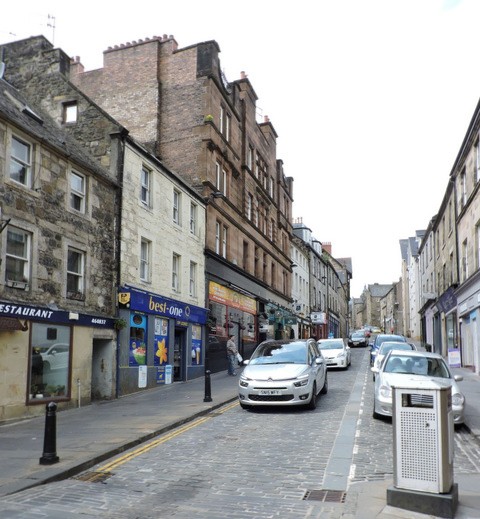
Upon his arrival in 1840, Archie discovered that surveying hadn’t even begun for the land he’d paid for. He had left his old life behind and travelled to the far end of the earth, only to be told that when he got here that it might be two or three years before he’d have a place to actually settle. “Oopsie!” said the New Zealand Company, but it was far from the only time they ever oopsied.
Archie didn’t let that hold him back, he ran a store for a while and bought some sheep and cattle, but when “the natives got troublesome” he decided to check out Otago’s prospects for running stock. Skipping a bit of drama and a wedding, he decided the south was the place to be after all, and arrived in the future town of Dunedin a full 15 months before its founding settlers, who while they greatly appreciated his help in the early days of the colony, did kindly ask him to move off the prime New Zealand Company land he’d been squatting on. We’ve visited his Belle Vue property in Roslyn before.
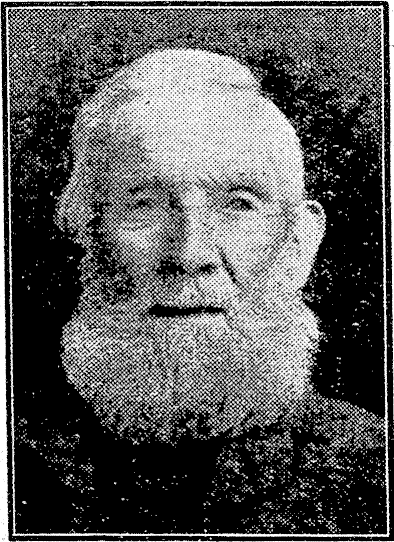
It was in1854 that Archie purchased his land on Inch Clutha, though he’d been running his stock in the wider area for some time. Finally, the surveyors caught up to him, and everything was made official. Moving there with his family, they dubbed their new home “Balmoral”.
The journey from Dunedin to their new home was probably made on foot, possessions packed on sledges to be dragged through the bush by bullocks. By that time, the journey from Dunedin to the Clutha had only once been made on horseback, and the alternative was to charter a boat to the river mouth and pay the local Māori to row them upstream.
Then there was the added difficulty of residing on an island. Sheep could be ferried over in small groups, horses towed, and cows driven over, but all these things were difficult and extremely time-consuming to do at scale. Archie himself ran a ferry service for a time. His son would say in later years that transport costs could eat up half the profit to be earned from the wool produced on the Island.
From 1864 the “Stirling Punt” operated, a sort of flat-topped ferry connected to a guideline spanning the river, slightly downstream of the modern Stirling bridge. The problem mixing flat-topped ferries with livestock is sometimes animals have a tendency to run about and tip the whole thing. Unlike the upstream punt at Balclutha, it doesn’t appear to have been linked to any fatalities, however there was a close call in 1869 when a bunch of unruly cattle ran to the rear end and upset the balance. Fortunately this mob were crossed safely, but then during the next load a bullock knocked the punt-man into the river where he was swept away by the swift current. Fortunately a quick-thinking bystander managed to get to him by boat and save the poor man from a “watery grave”, as the paper put it.
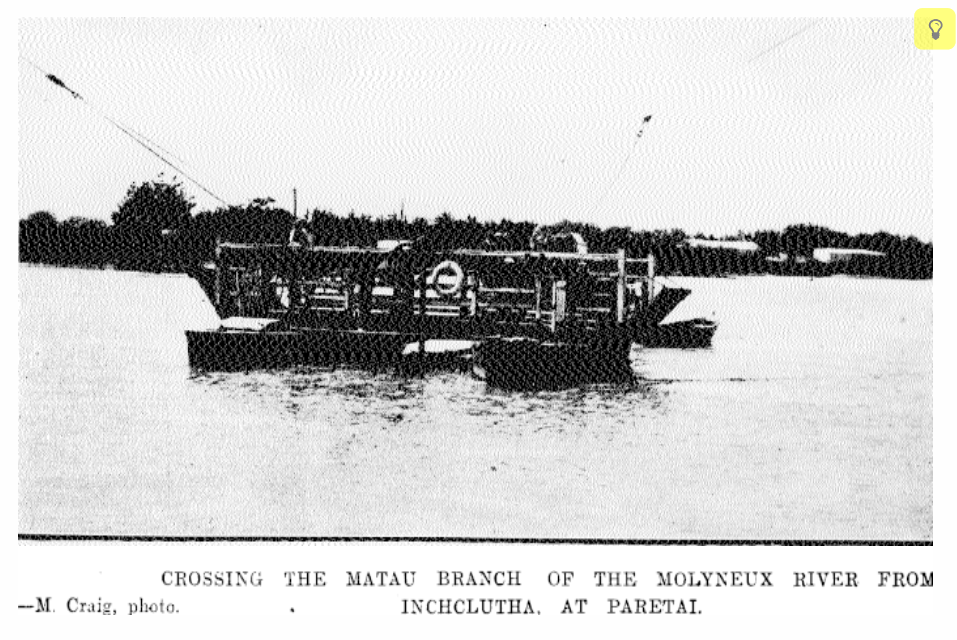
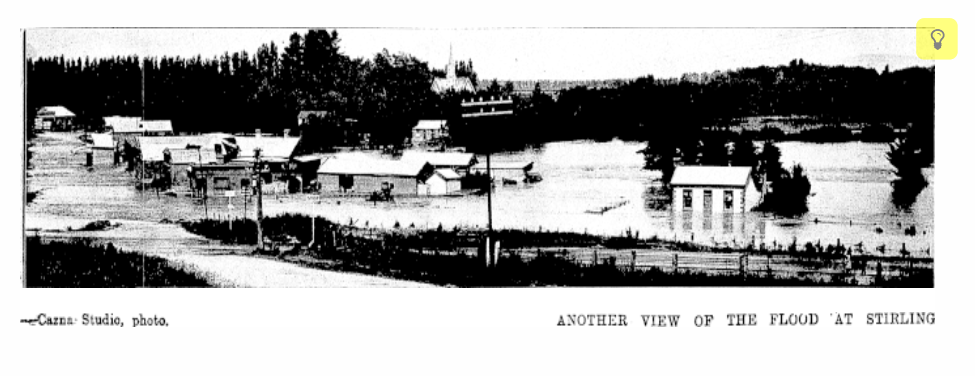
In 1876 before the installation of a bridge finally put an end to the precarious practice of punting, and this happily coincided with the next step needed to link Inch Clutha to the economic life of the region.
When the railway-man came to call in 1871, Archie was quick to offer a generous parcel of land for the proposed track. In fact, he offered it free of charge, provided two conditions were met. First, a station should be located at the punt crossing. Secondly, that place was to be called “Stirling”, after his place of birth (told you it would become relevant). Additionally, he surveyed out a number of township sections and offered them for sale – within two years a bustling township had sprung from the swamp: the station, two hotels, two smithies, a store, a stationer’s, a bootmaker, and a saddler, and a branch line bringing through coal from Kaitangata.
Although the Stirling Station is no longer in service, the track still swerves to the east after leaving Balclutha.
So much for Stirling, now for the church. We located it fairly easily, due to the fact it was the only mostly-collapsed burned-out husk in town.
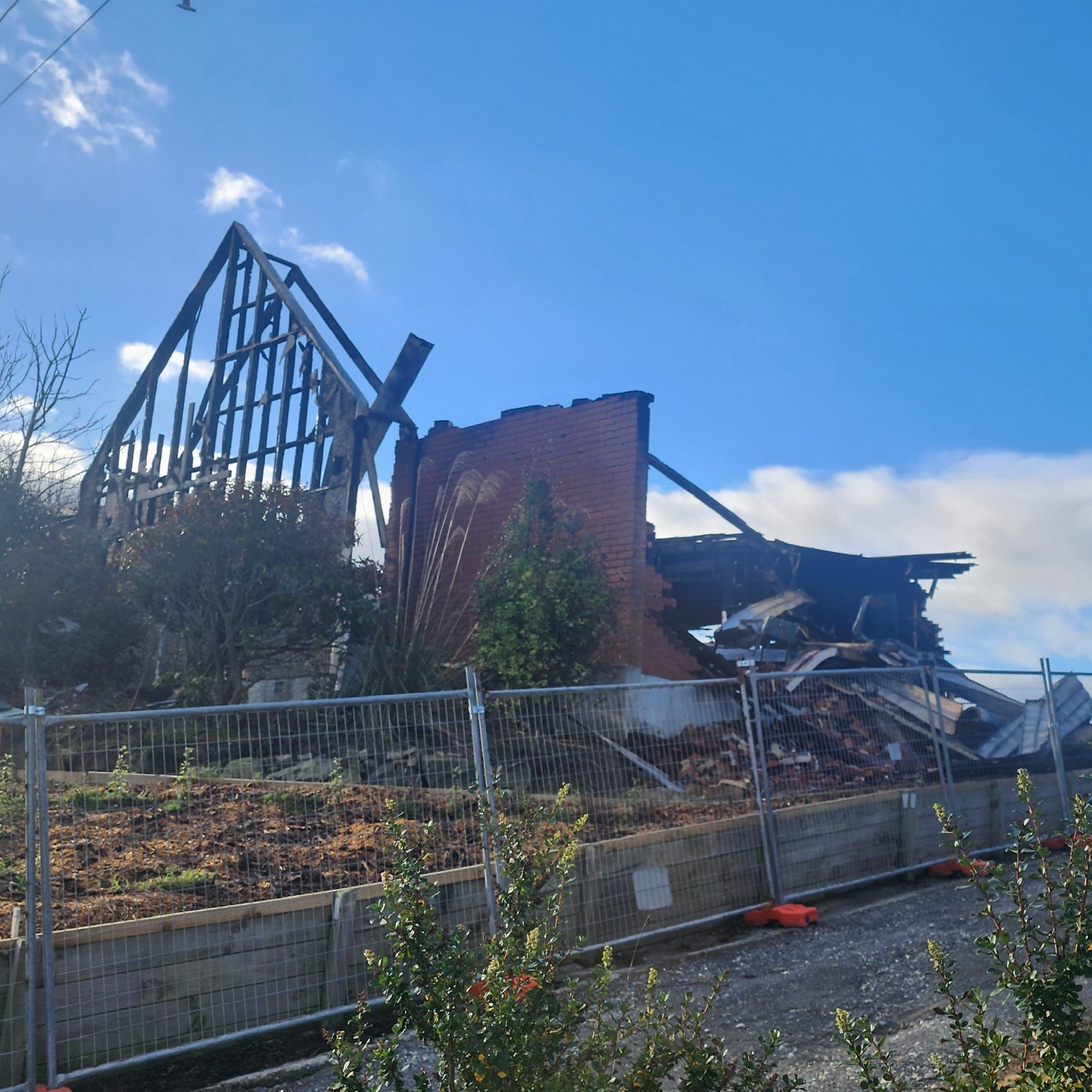
This site has been private property since the owners of the adjoining land purchased it in 2016.
Like a lot of churches these days, the Kaitangata-Stirling-Lovells Flat Presbyterian Church faces changing attendance patterns – a general drop in numbers combined with a modern ability and willingness to jump in a car and travel to somewhere more centralised for worship. There’s also new earthquake-proofing standards to contend with – these were sensibly put in place after the Christchurch Quake, but many churches simply haven’t the funds to bring their old buildings up to standard. Although many seem to think that religious organisations should be required to preserve buildings which have often become neighbourhood landmarks, their mission does not necessarily include preservation of historic buildings.
Kaitangata-Stirling-Lovells Flat (that’s quite a mouthful!) had an abundance of buildings, numbering five across three sites, and rotated their services among them. The sale removed Stirling from the rotation.
The church, too, owes its genesis to our tireless friend Archie. By the time he settled on the Inch, he already had a large brood of offspring (six daughters and two sons) whose education, both spiritual and worldly, he needed to secure. In 1856 he bought the site upon which the first church was to be erected. This was not the later Baker Street site, it was on the Island itself.
It was not until his wife Hannah passed in 1860 that he actually joined the Presbyterian Church (as an Englishwoman, she may have been Church of England), quickly becoming a deacon and then an elder. When in 1868 the initial church site became untenable, it was moved about a mile and a half down the island. Then it was decided an entire new building was in order, which was duly constructed, complete with a valuable bell gifted by Archibald Anderson, which tolled its first on 20 May 1877.
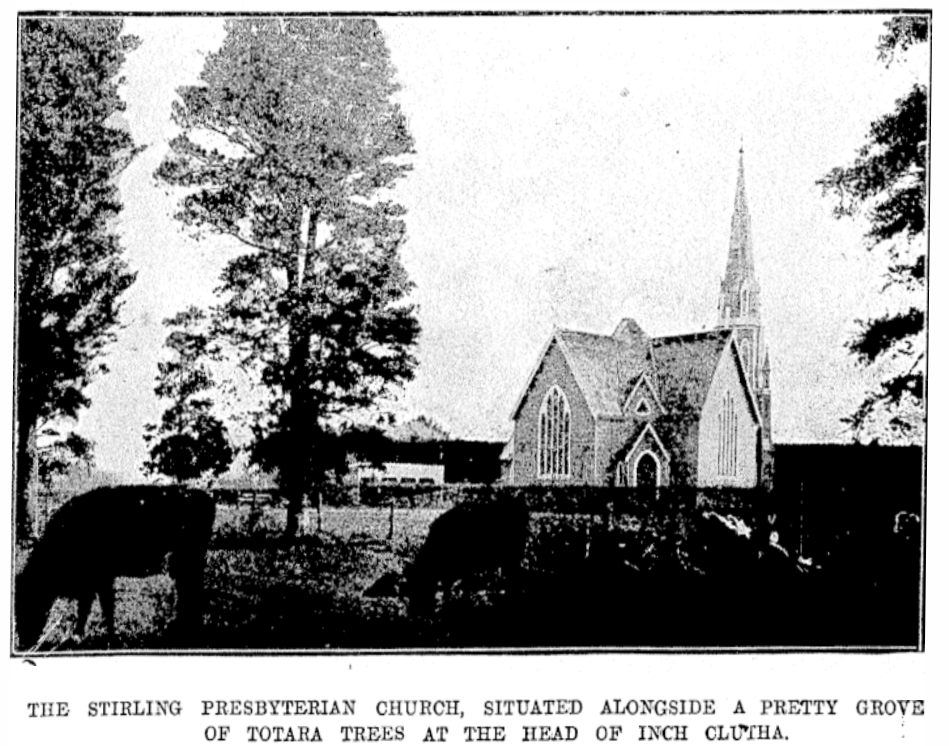
A century later, the Otago Catchment board decided that this building should be removed as part of a flood protection scheme. So a new church was planned, this time on the mainland at the Baker St site, upon which a hall had already been built. The last service of the second church was held on 17 September 1967, and the building demolished shortly thereafter, although the precious bell was salvaged.
The building that we came all this way to honour was designed by McAllum and Black, Architects. Built from brick veneer, it had seating for 148 people. It was built in 1969, and the bell was erected in its steel bell tower two years later, no bell-man required, since it could now be electronically activated by the flip of a switch.
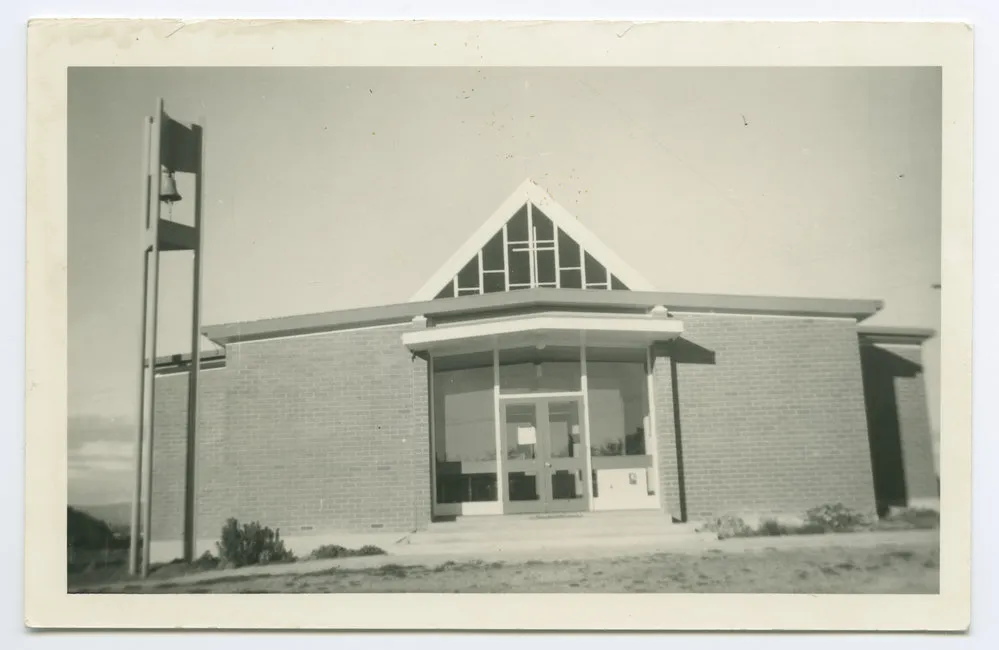
That, I believe, brings us back to where we started. You may be relieved to know that the bell was once again rescued, donated by the new private owners of the church building to Balclutha’s St Andrews Church when they purchased the property in 2016.
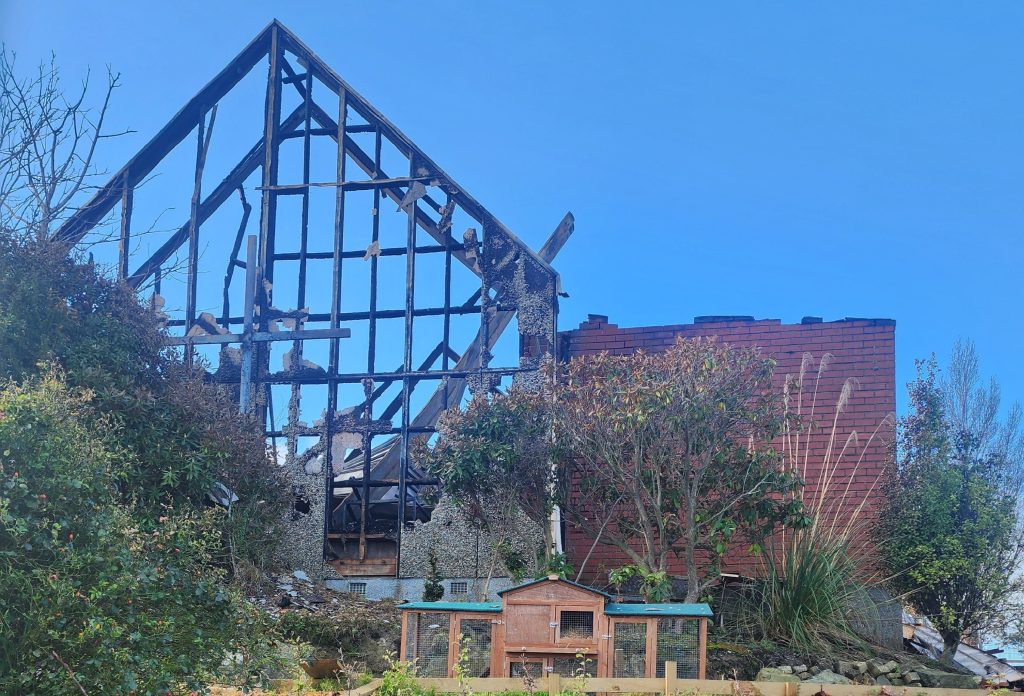
And now, Stirling’s last church has been reduced to ashes, another religious landmark excommunicated from a world no longer ruled by stern Presbyterian patriarchs in their isolated colonial communities. We travel with ease hardly dreamed of by settlers like Archie, and worship (or choose not to worship) each in our own way, with a freedom that would have scandalised our forebears. We find community through social media and the Internet, sometimes without knowing our own closest neighbours. I’m not interested in mourning some lost ideal of “traditional” values, nor do I think its worthwhile to judge ourselves superior to an ignorant and small-minded past. I think we’ve traded some things for others, and that’s the way of history. The true value of these stories, I think, is in the perspective they offer. Things have changed so much in just a century and a half, who knows what changes are still to come?
References:
Dirt bike spark may have caused church blaze by Laine Priestly
The Advance Guard, edited by George Griffifths
IN REMINISCENT MOOD Otago Daily Times, Issue 19066, 11 January 1924, Page 14
Parish puts church and hall on market by Helena de Reus
Church closure case of being asset ‘efficient’
River Punts and Ferries of Southern New Zealand by A.R. Tyrrell
The Inch by Alma M. Rutherford
Untitled Evening Star, Volume VII, Issue 1946, 31 July 1869, Page 2
Historic Clutha Presbyterian bell finds new home at Balclutha’s St Andrew’s Presbyterian Church by Mary-Jo Tohill